What Is a Bill of Materials (BOM)? A Complete Guide
What is a bill of materials (BOM)? Learn what a BOM includes, why makers need one, and how to build one to plan production and cost your products.
On this page
If you make anything from parts — candles, coffee blends, furniture, cosmetics, or packaged food — sooner or later you need to answer a deceptively simple question: what is a bill of materials? A bill of materials (BOM) is the master recipe for a finished product: a structured list of every component, ingredient, and quantity needed to build one unit. Get it right and you can cost your products accurately, buy the correct amount of raw material, and keep production running without last-minute shortages. Get it wrong and you overspend, oversell, or grind to a halt mid-batch.
This guide covers the BOM meaning in plain terms, what a good BOM includes, the difference between single-level and multi-level structures, a worked bill of materials example, and a step-by-step method for how to create a BOM you can actually maintain.
Bill of materials (BOM) definition
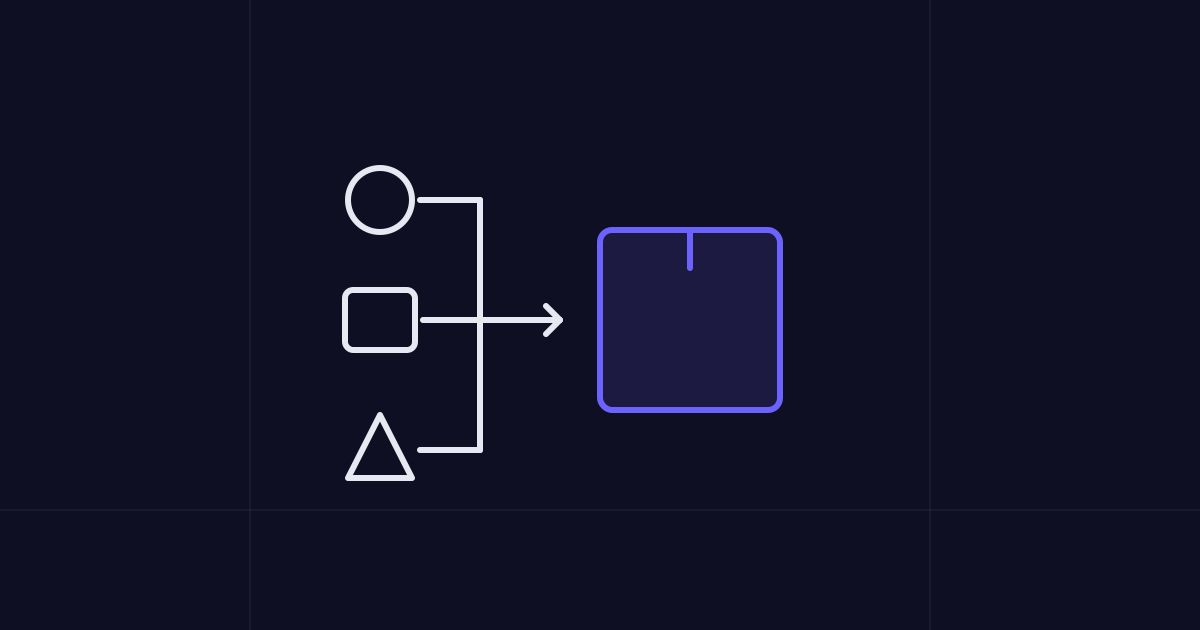
A bill of materials is a complete, itemized list of the raw materials, sub-assemblies, and quantities required to manufacture one unit of a finished product. Think of it as the difference between a chef's memory and a written recipe: the BOM makes the "how many of what" explicit, repeatable, and shareable across your team.
The concept comes from manufacturing, but it applies to any small business that turns inputs into outputs. A soap maker's BOM lists oils, lye, fragrance, and packaging. A brewery's BOM lists malt, hops, yeast, water, and cans. The BOM meaning is the same in every case — it is the authoritative definition of what goes into the thing you sell.
What a BOM includes
A usable BOM captures more than just a list of parts. At minimum, each line should tell you what the component is, how much you need, and how it is measured. Most small-business BOMs include the following fields:
- Component name and part number — a unique identifier so there is no ambiguity between similar items.
- Quantity per unit — how much of that component one finished product consumes.
- Unit of measure — grams, millilitres, each, metres. Mixing units is one of the most common BOM errors.
- Component type — raw material, sub-assembly, or packaging.
- Unit cost — used to roll up the total material cost of the finished product.
- Notes or supplier — lead-time reminders, substitutes, or the vendor you buy from.
Here is a simple bill of materials example for a 200 g scented candle:
| Component | Qty per unit | Unit | Unit cost | Line cost |
|---|---|---|---|---|
| Soy wax | 180 | g | $0.008 | $1.44 |
| Fragrance oil | 18 | ml | $0.12 | $2.16 |
| Cotton wick | 1 | each | $0.15 | $0.15 |
| Glass jar + lid | 1 | each | $1.10 | $1.10 |
| Label | 1 | each | $0.09 | $0.09 |
| Total material cost | $4.94 |
That single table already tells you your floor price. If your material cost is $4.94, you know a $9 retail price barely covers labour and overhead — and that insight comes straight out of the BOM.
Types of BOM: single-level vs multi-level
BOMs come in two broad structures, and choosing the right one depends on how much sub-assembly your product involves.
Single-level BOM
A single-level BOM is a flat list: the finished product on top, and every component directly beneath it with no nesting. The candle example above is single-level. It is easy to read and perfect for products assembled from raw materials in one step. The trade-off is that it hides intermediate stages — if a component is itself made in-house, a flat list won't show how.
Multi-level BOM
A multi-level BOM (also called an indented BOM) nests sub-assemblies inside the parent product. Imagine a gift box that contains a candle, a bar of soap, and packaging. The candle is a finished product with its own BOM; the soap has another. The gift-box BOM references those sub-assemblies rather than re-listing their raw ingredients.
Multi-level structures keep each recipe maintainable: change the candle's wax supplier once, and every product that includes a candle inherits the update. For makers who batch intermediate goods before final assembly, multi-level BOMs are the only structure that scales. You can read more about the broader picture in our guide to inventory for makers and manufacturers.
How a BOM helps you cost and plan production
A BOM is not paperwork for its own sake — it is the engine behind two decisions you make constantly: what a product truly costs, and how much raw material to buy.
Costing
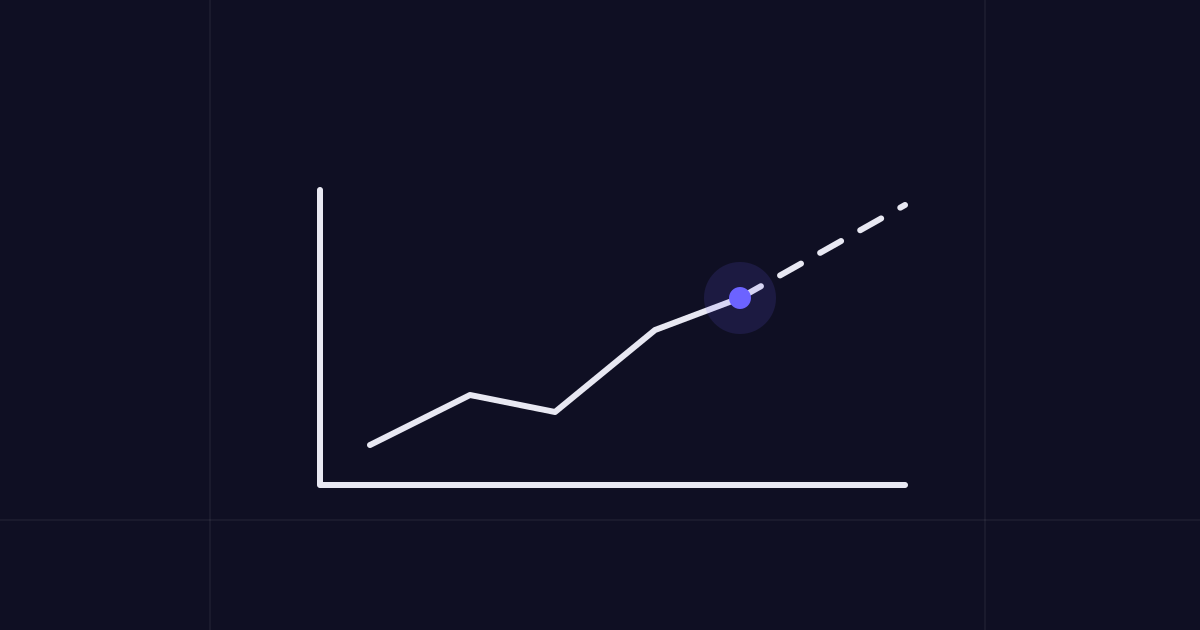
Because every line carries a quantity and a unit cost, the BOM rolls up into a precise material cost per unit. The basic formula is unit material cost = Σ (component quantity × component unit cost). Add labour and overhead on top and you have a defensible price. Without a BOM, most owners guess — and guesses usually run low.
Production planning
Multiply the BOM by a production run and you get a shopping list. Building 500 candles means 500 × 180 g = 90 kg of wax and 500 × 18 ml = 9 litres of fragrance. Compare that against stock on hand and you know exactly what to reorder before you start. Pair this with the demand estimates from our article on demand forecasting for small businesses, and purchasing becomes a calculation rather than a scramble.
Always link your BOM quantities to a single unit of the finished product, never to a batch. It's trivial to multiply one unit by any run size, but a BOM defined "per batch of 40" becomes useless the day you want to make 37.
How to create a bill of materials step by step
Here is a repeatable process for how to create a BOM that stays accurate over time:
- Pick one finished product and define exactly what one sellable unit is (a 200 g candle, a 250 g bag of coffee).
- List every component that ends up in or on that unit — including packaging, labels, and consumables people forget.
- Assign quantities and units of measure to each line, and standardise your units so grams never get confused with millilitres.
- Weigh or measure a real build to validate quantities. Estimated figures drift; a measured build is ground truth.
- Add unit costs from recent supplier invoices so your material cost reflects today's prices.
- Identify sub-assemblies and split them into their own BOMs if you make them in-house, moving to a multi-level structure.
- Version and date it. When a recipe or supplier changes, record the change so you can trace cost shifts later.
Forgetting minor consumables — glue, tape, spare wicks, wastage — is the most common reason a BOM under-costs a product. Build in a small allowance for scrap; a 3–5% wastage line on high-loss materials keeps your numbers honest.
Managing BOMs in inventory software
A spreadsheet BOM is a fine starting point, but it doesn't move your stock. The moment you build a product, someone has to remember to deduct wax, wicks, and jars from inventory by hand — and that manual step is where errors creep in. Inventory software closes the loop by tying each BOM to live stock levels.
This is exactly where Shelvr's BOM and production features earn their keep. Makers define a recipe once, and whenever you record building a finished product, Shelvr auto-deducts every component from stock in the right quantities. Because it is offline-first, you can log a production run on the shop floor without a signal and let it sync later. Combined with low-stock alerts, you get warned before you run out of a critical ingredient mid-run.
The payoff compounds: accurate BOMs feed accurate costs, accurate costs feed better pricing, and auto-deduction keeps your on-hand numbers trustworthy enough to plan the next batch. If you want to see it in action, you can try Shelvr in your browser and set up your first recipe in a few minutes.
A bill of materials is the single source of truth that connects what you make to what it costs and what you need to buy. Write it down once, keep it current, and let your software do the arithmetic.
Run your inventory in one app
Track stock, orders, and production across web, iOS, and Android — free to start.