Inventory for Makers & Small Manufacturers
Inventory for makers and manufacturers: manage bills of materials, track raw materials, plan production runs, and always know what you can build.

On this page
If you build things to sell — candles, furniture, sauces, jewelry, electronics kits — you already know that inventory management for small manufacturers is a different animal than it is for a shop that just resells finished products. You are not tracking one number per SKU. You are tracking raw materials coming in, half-finished builds sitting on the bench, and finished goods going out, all at once. Get the connections wrong and you either run out of a $2 component mid-run or tie up thousands of dollars in wax you will not use for six months.
This guide walks through the specific challenges makers face, how to think about the three inventory states, how bills of materials keep component counts honest, and what to look for in software so you can plan production without spreadsheets falling apart.
Inventory challenges for makers and small manufacturers
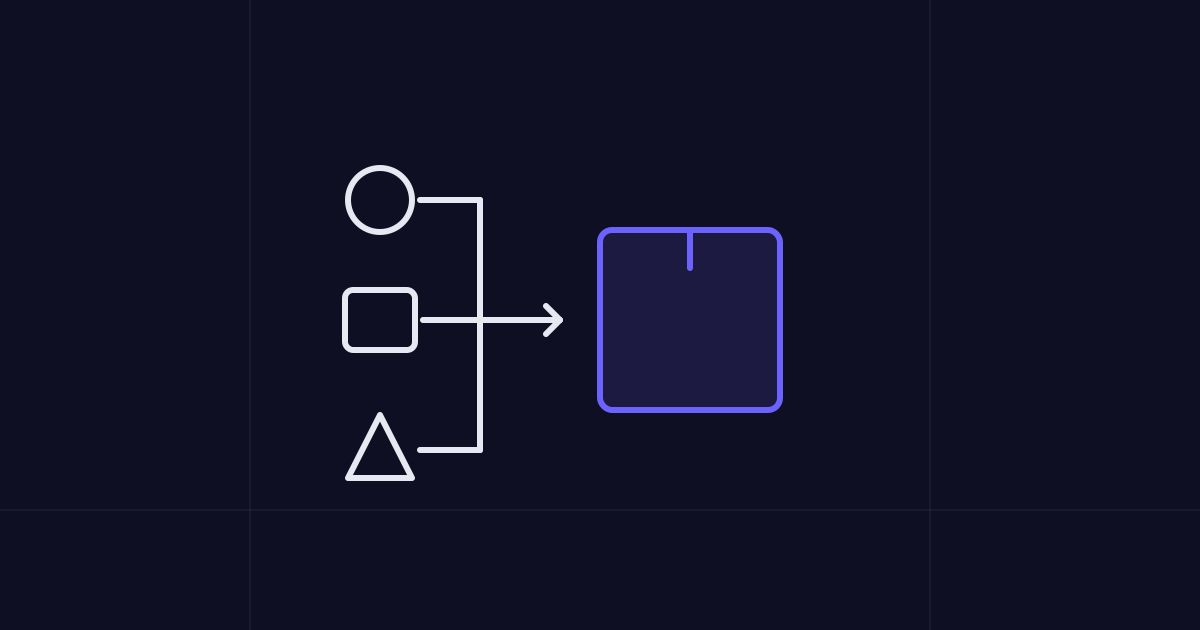
The core problem is that your stock is constantly transforming. A sheet of plywood becomes table legs becomes a finished desk. Each step changes the count of several different items simultaneously. A resale business decrements one line when a sale happens; a maker decrements five raw materials and increments one finished product with every build.
That creates a handful of headaches that generic inventory tools handle poorly:
- Shared components. One brass fitting might appear in eight different products. When you sell any of them, that fitting's stock needs to drop — and you need to know your true "buildable" quantity across all products.
- Unit mismatches. You buy fragrance oil by the liter but use it by the milliliter. You buy fabric by the yard and cut it by the inch.
- Lead times that stack. If a key material takes four weeks to arrive, a stockout does not cost you a day of sales — it costs a month of production.
- Batch and expiry. Food, cosmetics, and chemicals carry lot numbers and use-by dates you are often legally required to trace.
Miss any of these and your "in stock" number becomes fiction the moment production starts.
Raw materials vs work-in-progress vs finished goods
Accountants split manufacturing inventory into three buckets, and it is worth adopting the same mental model because each behaves differently and ties up cash differently.
| Stage | What it is | Example | Typical cash tied up |
|---|---|---|---|
| Raw materials | Inputs you buy but have not processed | Wax, wicks, jars, fragrance | High |
| Work-in-progress (WIP) | Partially built, not yet sellable | Poured candles curing overnight | Medium |
| Finished goods | Ready to ship or sell | Labeled, boxed candles | Low to medium |
For very small operations, WIP is often short-lived enough that you can skip formally tracking it and simply convert raw materials straight into finished goods at the moment of a build. But if your process has a real hold step — curing, drying, aging, kilning — treating WIP as its own state prevents you from double-counting materials you have already committed.
Value each bucket separately at month-end. If raw materials keep climbing while finished goods stay flat, you are over-buying inputs and starving cash flow — a signal to tighten purchasing before it becomes a garage full of unused stock.
Using bills of materials (BOM)
A bill of materials is the recipe for a product: the list of components and quantities needed to build one unit. It is the single most important structure in manufacturing inventory software, because it is what links your finished-goods count back to raw materials.
A simple BOM for one scented candle might read:
- 200 g soy wax
- 1 cotton wick
- 1 glass jar (8 oz)
- 15 ml fragrance oil
- 1 printed label
Once that recipe exists, building 50 candles is not 250 manual adjustments — the software deducts component qty × build qty from each raw material automatically and adds 50 to finished goods. This is exactly where Shelvr's bills of materials and production features earn their keep: you define the recipe once, and every build keeps component counts honest without hand math.
If you are new to the concept, our deeper explainer on what a bill of materials is covers nested BOMs, sub-assemblies, and how to handle variants.
Buildable quantity
A well-built BOM also answers the question makers actually care about: how many can I make right now? The answer is limited by your scarcest component. If you have wax for 60 candles but only 40 jars, your buildable quantity is 40 — and jars are what you need to reorder, not wax.
Planning production runs
Production planning is where BOMs and demand meet. The goal is to make enough to cover expected sales without over-committing materials or cash. A practical planning loop looks like this:
- Forecast demand for each finished product over your planning window (say, the next four weeks).
- Check current finished-goods stock and subtract it from the forecast to get how many you actually need to build.
- Explode the BOM — multiply each product's component list by the build quantity to get total raw materials required.
- Compare against materials on hand and generate purchase orders for anything short, factoring in supplier lead times.
- Schedule the run and let the build deduct components when it is done.
For the forecasting step, do not guess from memory. Our guide to demand forecasting for small businesses walks through simple methods that beat gut feel. A reasonable reorder trigger for a raw material is reorder point = (avg daily usage × lead time in days) + safety stock — buy before you hit that number, not after.
Seasonality matters more for makers than resellers because your lead times compound. A candle maker planning for the holidays needs materials ordered in early autumn, since a four-week fragrance lead time plus a curing step plus fulfillment can eat a month and a half.
Tracking material costs and margins
Because a BOM lists exact quantities, it also gives you an exact unit cost — which is the foundation of knowing whether you are actually making money. Roll up the cost of every component in the recipe and you have your cost of goods for one unit.
| Component | Qty | Unit cost | Line cost |
|---|---|---|---|
| Soy wax | 200 g | $0.012/g | $2.40 |
| Glass jar | 1 | $1.80 | $1.80 |
| Fragrance oil | 15 ml | $0.09/ml | $1.35 |
| Wick + label | 1 ea | — | $0.55 |
| Total build cost | $6.10 |
If that candle retails at $22, your gross margin is (22 − 6.10) ÷ 22 ≈ 72% before labor, shipping, and fees. Track this per product and you will quickly spot the SKUs that quietly lose money — usually the ones with fiddly components or high waste. Speaking of which, tracking scrap and spoiled batches is part of the true cost picture; the same discipline applies whether you make candles or croissants, as our bakery inventory management guide shows.
The cheapest way to improve margin is rarely raising prices — it is knowing your real build cost and cutting the waste you did not know you had.
Software for maker and manufacturer inventory
Spreadsheets get you started, but they break down exactly where inventory management for small manufacturers gets interesting: shared components, automatic deductions, unit conversions, and buildable quantities across dozens of products. When you evaluate inventory for makers tools, look for a few non-negotiables:
- Multi-level bills of materials with unit conversions built in.
- Automatic component deduction on each build, so raw material tracking stays accurate without manual edits.
- Batch and expiry tracking for anything perishable or lot-controlled.
- Low-stock alerts tied to reorder points and supplier lead times.
- Offline access, because workshops, kitchens, and market stalls do not always have reliable Wi-Fi.
This is the workflow Shelvr is built around. Its bills of materials and production features let you plan builds, deduct components automatically, and track raw materials right alongside finished goods — with batch, expiry, and low-stock alerts included. Because it is offline-first, you can run a build on the shop floor and it syncs when you reconnect. You can try it in your browser and see how a BOM-driven build feels compared to juggling tabs.
Before committing to any tool, build one real product end-to-end: create its BOM, run a build, and confirm the right materials dropped by the right amounts. If a platform cannot deduct components cleanly from a single build, it will not survive a busy production week.
Makers do not need enterprise MRP with a six-month rollout. You need a clear split between raw materials, WIP, and finished goods; accurate BOMs; a simple planning loop; and honest per-unit costs. Nail those four and you will build the right amount, at the right cost, without the garage full of surprises.
Run your inventory in one app
Track stock, orders, and production across web, iOS, and Android — free to start.