Demand Forecasting for Small Business (Without the Guesswork)
Demand forecasting for small business, minus the guesswork: use sales history and trends to predict what to reorder and how much to keep in stock.
On this page
Every time you place a purchase order, you are making a bet on the future. Order too much and cash sits on your shelves gathering dust (and sometimes expiring). Order too little and you lose sales, disappoint customers, and scramble for a rush shipment. Demand forecasting for small business is simply the practice of making that bet smarter — using what you already know about your sales to predict what you will need next week, next month, or next season. Done well, it replaces gut feel with a repeatable method that anyone on your team can follow.
The good news: you do not need a data science team or expensive software to get started. You need your sales history, a handful of simple formulas, and a habit of reviewing the numbers. This guide walks through the methods that actually work for a shop, cafe, workshop, or online store.
What is demand forecasting?
Demand forecasting is the process of estimating how much of a product your customers will buy over a future period. It answers a practical question: "If I keep doing what I'm doing, how many units of this item will I sell in the next 30 days?" That estimate then drives your reorder decisions, staffing, and cash planning.
It helps to separate two related ideas. Inventory forecasting predicts the stock you need to hold to meet demand without running out. Sales forecasting for inventory predicts the units you will sell. They feed each other: your sales forecast becomes the input, and your inventory plan becomes the output. Get the sales side roughly right and the inventory side follows.
A forecast is not a promise — it is your best estimate given the data. The goal is to be usefully close most of the time, then adjust as reality comes in. Even a rough forecast beats reordering from memory.
Why small businesses need it
Large retailers can absorb a bad guess. A small business often cannot. When your working capital is tight, every over-ordered pallet is money you cannot spend on rent, payroll, or marketing. That is why demand planning for small business matters more, not less, when you are small.
Concretely, a good forecast helps you:
- Free up cash — hold less dead stock and stop paying for storage you don't need.
- Avoid stockouts — keep your best sellers available so you don't hand sales to a competitor.
- Buy at the right time — order early enough to cover supplier lead times without panic buying.
- Cut waste — for perishable or batch-dated goods, forecasting stops you from over-ordering items that expire before they sell.
Forecasting also connects directly to your reorder math. Once you know expected demand, you can set a sensible trigger point using the reorder point and safety stock formula so replenishment happens automatically instead of in a last-minute rush.
Simple forecasting methods that work
You do not need a complex model. Three approachable methods cover most small businesses, and you can layer them as you grow.
1. Moving average
Take the average of recent periods to smooth out random spikes. If you sold 40, 52, and 46 units in the last three months, your forecast for next month is (40 + 52 + 46) / 3 = 46 units. It is simple, stable, and great for products with steady demand.
2. Weighted moving average
Recent sales usually predict the near future better than older sales, so give them more weight. For example, weight the last three months 50% / 30% / 20%: (46 × 0.5) + (52 × 0.3) + (40 × 0.2) = 46.6 units. This reacts faster when demand is trending up or down.
3. Trend (run rate) projection
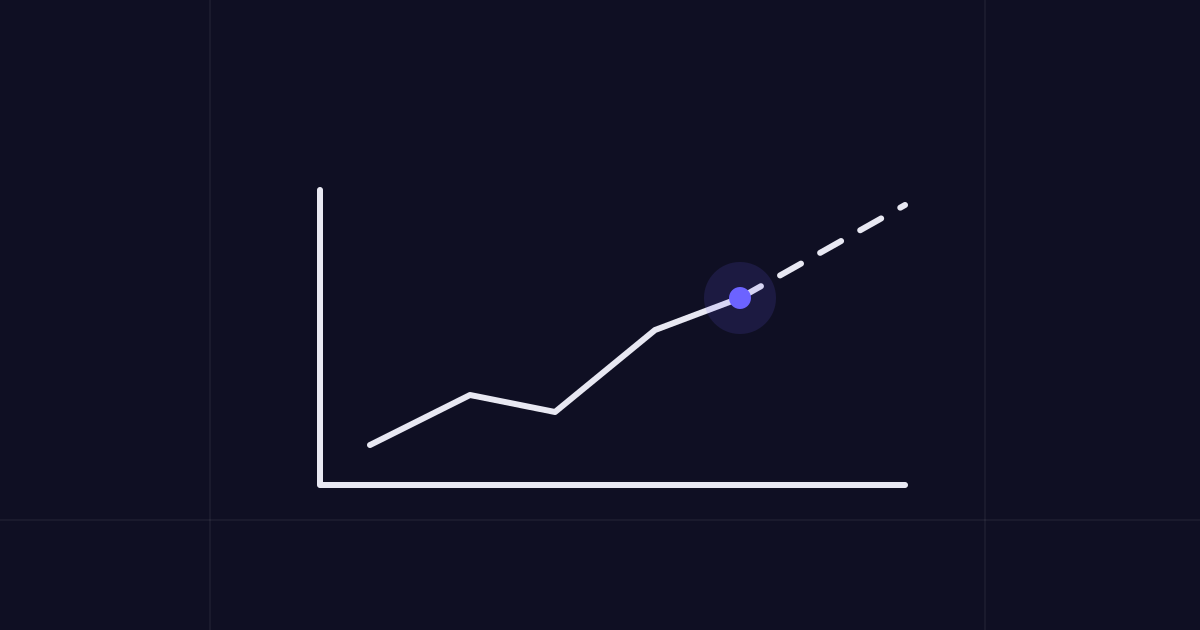
If sales are climbing steadily, project the line forward. Growing from 40 to 46 to 52 is roughly +6 units per month, so next month you might plan for about 58. Use this cautiously — trends bend, and no product grows forever.
| Method | Best for | Example forecast |
|---|---|---|
| Moving average | Stable, steady sellers | 46 |
| Weighted average | Gently shifting demand | 47 |
| Trend projection | Clear upward or downward trend | 58 |
Using sales history and trends
Your own sales records are the single best predictor you have — better than any industry benchmark, because they reflect your customers, your prices, and your location. Effective demand forecasting for small business starts by getting that history clean and in one place.
Work item by item, because different products behave differently. A fast mover with 12 turns a year needs frequent, smaller orders; a slow mover needs the opposite. If you are unsure how quickly a product sells through, calculate its inventory turnover ratio — it tells you how many times you sell and replace that stock in a year, which shapes both your forecast horizon and your order size.
This is where software earns its keep. Shelvr's demand planning uses your own sales data to suggest what to reorder and how much, so you buy the right amount at the right time — no spreadsheet gymnastics required. It watches each item's real sell-through and flags what needs attention.
If you build or assemble products, forecast at the component level too. When you know how many finished units you will sell, a bill of materials lets you roll that up into exactly how many raw parts and ingredients to buy.
Planning for seasonal demand
Averages fall apart around the holidays, the summer rush, or your industry's busy season. A flat monthly average will leave you short in December and overstocked in January. The fix is to compare each period against the same period last year, not the month before.
A quick way to handle this is a seasonal index. Divide each month's sales by your average month to get a multiplier. If December typically runs 1.8× a normal month, plan for 1.8× your baseline forecast heading into December. Then layer in known events — a promotion, a local festival, a supplier price change — that history alone can't see.
The best forecast blends the numbers with what you know: your data tells you the pattern, and your judgment catches what the data can't.
Order seasonal stock earlier than feels comfortable. If your supplier's lead time is three weeks and demand peaks in December, your peak order should be placed in early November — the forecast is only useful if it beats the lead-time clock.
Demand planning tools for small business
You can absolutely start with a spreadsheet — a weighted moving average and a seasonal index will take you a long way. But spreadsheets go stale the moment your sales change, and they don't tell you when to act.
Purpose-built demand planning tools for small business close that gap by connecting live sales to reorder suggestions. Instead of you exporting data every month, the system tracks sell-through continuously and tells you what to buy. Shelvr does this offline-first across web, iOS, and Android, so your inventory forecasting stays current whether you're at the counter or the stockroom. You can explore it free at web.shelvr.app and let your own numbers do the planning.
Whichever route you choose, the principle is the same: stop guessing, start measuring. Pick one method, apply it to your top ten products, and review it monthly. Within a quarter you'll have a forecast you trust — and a lot less cash stuck on your shelves.
Run your inventory in one app
Track stock, orders, and production across web, iOS, and Android — free to start.